Saturday, March 29, 2014

On Coming to Nootka

At last, I'm back working as a relief lightkeeper, this time at Nootka. I was going to write a blog to describe the geographic area and provide some background (this is a hotspot for Canadian history); however, a friend sent this one to me. It's quite well written, so I'm just going to post it, thank Heike, and thank the sailors who took the time to write it.


I arrived on Thursday. The weather was gorgeous…sunshine, warmth, no wind…needless to say, the helicopter ride from Victoria was picture perfect. Just me and the pilot cruising quietly up the coast.


Riding shotgun is awesome because you get such great views.


Even the waves were perfect!


We stopped in at Carmanah Lighthouse to drop off some mail. The sun was shining directly behind the light here.


Later, we put down at Tofino airport to refuel.


Anyone who's ever hiked or kayaked the West Coast likely knows Ucluelet. Here's a photo coming into town from the south. Like other communities on this rugged coast, Ucluelet is built on the ancestral territory of the Nuu-chah-nulth First Peoples. They lived "all along the mountains and the sea" which is what Nuu-chah-nulth means. 


Here's our first sighting of Friendly Cove and Nootka Lightstation.


Some Mowachaht/Muchalaht folks are sharing this beautiful space with us. The Williams family is still living on the beach behind the lightstation, where the Yuquot village once stood.


The last two days, it's been raining off and on, light and heavy, pretty much nonstop. Today is a perfect day for listening to that crazy Icelandic band, Sigur Ross…knitting, collecting thoughts, sea-gazing, and drinking tea. I'm so glad to be back.


Sunday, December 29, 2013

Lighthouse Keeping (Part 1 -- Physical Rigors)


When I say, I am a lighthouse keeper, most people are surprised. Unknowingly they smile. Do they still exist? How did you even think of doing that? Is there training? How did you get the job? I understand this fascination; asked many of the same questions myself when my friend became a keeper a few years ago.
Romantic. Captivating. The Lighthouse. That fiery beacon by the misty sea is ingrained in our ancestral memory. If you’ve ever dreamed of living in a tower, stirring up a cauldron of chowder, or sipping tea as you scan the horizon for foundering ships, you know what I mean. But be forewarned. As merry as it seems, lighthouse life is not a dream.

In my late fifties, I wanted a new career, something different from my stressful, chaotic, sedentary high school teaching job, something that would allow me to think and write and create.

When the online job posting appeared at last, I applied and waited, interviewed and waited; and finally, was informed that if I passed the medical, I would be accepted as a candidate. Assistant lightkeeper. Entry level position: relief. Much like a teacher-on-call, I would fill in for someone going on leave. Variable times. Various locations along the coast. Yes please.

But, being a lighthouse keeper is demanding: physically, mentally, and emotionally.

Because stations are in remote locales, you must be in good health. If you’re on any kind of medication, you must remember to bring plenty with you. There’s no slipping out to the 24 hour pharmacy.  

There are still twenty-seven staffed lighthouses on the B.C. coast, and each is unique. As a relief keeper, I travel between them, work with different Principal Keepers, and stay in different houses. Some are bungalows, some are two-storey, some are spare houses sparsely furnished; while other--especially if it’s a keeper’s residence--are cozy and comfortable. But, if you don’t like sleeping in different beds, this is not the job for you. It's capital G Glamping.

Though we don’t live in the light towers, we do climb inside them. Someone has to clean those windows and make sure everything is functioning as it should.

Tower Stairs at Lennard Island

And we climb stairs, countless stairs, and cement steps, some ancient and uneven. We scramble up and down ramps, hike forested trails (whenever possible) and pick our way through rocks and boulders. It’s all hard on the hips and knees. I’m petite, so even getting in and out of the helicopter is a challenge for me. 

Apart from doing a marine weather report every three hours, lightkeepers take care of the station, inside and out. Here’s just a sampling of work I’ve done in the last few months:
  • Dipping diesel fuel tanks from atop a ladder.
  • Helping to refuel domestic tanks.
  • Dipping cisterns. Rainwater collects in a 5,000 gallon cistern in the basement and is filtered for drinking. Filters require changing.
  • Scraping and painting buildings, decks, and walkways.
  • Testing the fire pump and hoses, and checking fire extinguishers. 
  • Pumping up the zodiac and angling it down the high line
  • weed-wacking, hedge-trimming, grass-cutting 


At one station, armed with trimmers and clippers, I battled English ivy, knowing full well that in weeks, it would be back, sucking the life out of every living thing in its path. Carving a space in the salal is a constant challenge.


Still, wearing personal protective equipment, we maneouvre and maintain self-propelled lawnmowers--my personal bane--weed-whackers, hedge-clippers, tractors, and pressure-washers. We are coastal caretakers.

Lifting. Besides packing in all of our own food--that’s a whole story in itself--when there is a grocery tender, lightkeepers unload boxes from the helicopter, deposit them in a trailer, and then carry them gleefully into the house. Those days are like Christmas.

You should be able to lift about fifty pounds. When I fell at the beginning of August and injured my back, I had to stay off work until I was healed sufficiently; in fact, I had to see a Coast Guard doctor before returning to the job.

Not exactly sipping hot tea by the sea.


So, what do I love about being a lightkeeper? The adventure. 


Carmanah from the Air

Lift off in the helicopter.


Driving the tractor. (That's all my gear)


Boating. Hiking. 
Watching and recording whale sightings. 
Eagles. Ravens. Seals and sea lions. 

Clouds that are never the same twice.
The wind. Even the rain.
Challenging my mind and body to perform. 
Time to think and write and create. 
Living deliberately, as Thoreau would say.  


And especially those times when I do get to sip hot tea by the sea.

Tuesday, December 17, 2013

Nightwatch


The most critical duty of a lighthouse keeper is to observe and report a marine weather forecast* every three hours. It is human eyes and ears, that experience standing beside this Pacific sea, and record it for the benefit of all who use this “whaleroad”. Some keepers also observe the skies and provide aviation reports much needed by pilots. Etched up and down the west coast of Canada from Victoria to Alaska, we are a scattered chain of observers, linked by Coast Guard radio.


www.fogwhistle.ca/bclights

As I listen to the other keepers report, I am always curious. No two of us ever give the same report; in fact, the weather is often vastly different. The nearest station to us may report visibility of 15 miles, while we are obscured by fog, or it may be raining there, while I am basking in starlight. This is why human observation at lightstations is critical.

The first report comes early: 3:30am. Awakened by my alarm--best to set two I’ve discovered--I slip into clothes, boots, toque, glove, jacket and don a miner’s headlamp. As I walk down the stairs I wonder: what will I discover when I open this door? I’ve not spent much time in this life wandering about at 3am anywhere, let alone on the edge of the sea. And, the experience is never the same.

Two weeks ago, during a cold spell, the skies were so clear, I was stargazing under the dark moon. Pointing my iphone to the myriad constellations that sparkled above, and using my new “Star Chart” app, I was able to pinpoint Jupiter in the constellation Twins. Directly west and low in the Pacific sky, it is one of the biggest brightest stars. 

A few nights last week, under the waxing moon, I could walk the cement trails of the station without need of the headlamp. And one night, while sauntering across the landbridge, I looked to my left and was surprised by my own “moonshadow”.  I’ve been listening to Cat Stevens sing that tune for years, but that was the moment, I actually understood his words.

Today, we are obscured by fog. I can see no more than 1/8 of a mile and light rain is falling. The wind is up to 15 knots, blowing from the southeast, and it’s necessary to not only use my headlamp, but to gather up my hood. (I really hope it clears because groceries our scheduled to arrive today by helicopter.) 

The full solstice moon lies hidden on the far side of a stratus bank; still, I know she’s there. We are creeping towards the longest darkest night of the year. 

Winter Solstice occurs in Vancouver, this Saturday, December 21, 2013 at 9:11am PST. It is the longest darkest night of the year, and therefore a fitting time to celebrate with light.


GoTofino: Supermoon


*The Marine Weather Forecast includes: sky state, visibility in miles, wind direction and speed in knots, and sea state (wave size and swell). 


Thursday, December 12, 2013

Oh the Wind and Rain

When I came out of the office this morning after reporting the 6:40am weather, I had to hold on ... to my hood ... to the wall. With southeast winds gusting 28 knots (that is 52 km/hr ... think of driving through town) that corner of the station was getting walloped. The wind, of course, churns up the sea, so we had some roaring waves breaking off the rocks.

This is the kind of thing that makes Tofino a surfers' and stormwatchers' paradise -- although this is technically not a storm. This is just a little wind and rain ... light rain, to be exact; what the Beaufort Scale calls a "strong breeze" ... close to a "near gale".

Below is a map of Tofino. You can see where we are, just to the west of Chesterman Beach (which is touted to be one of the best surfing spots in North America. Surfing Tofino

http://www.tourismtofino.com/maps-resources


Below is a photograph I took after the 9:40am marine weather. The wind has settled some, but we're still seeing a moderate SW swell and some decent waves breaking off the rocks. Chesterman Beach lies along that foggy line of pines in the top lefthand corner.


And, here's another of the breakers just west of the station. No storm yet, but hey, I'm here for another week. If we really do get one of those storms, we'll likely have to lash me to the railings. Oh the wind and rain!


Saturday, December 7, 2013

Alive Alive O!

"When the tide is out, the table is set."

I heard a Musqueam elder say this a few years ago at a Vancouver gathering, but its echoes are much older. Any of the First Peoples who've been living along this western coast since time immemorial know it, and know it well. This is the first day I've lived it.

We've been talking about gathering mussels all week, but the time just wasn't right. For one thing, you need a low tide, and this time of year when daylight is limited, low tides are scarce. In fact, they become increasingly later in the day over the next week, and by December 15, as we move closer to Winter Solstice, low tide occurs in the dark.

Today, I took advantage of a low tide at 9:45am. Perfect. Right after my last weather. I wanted to check out the tide pools and see what I could photograph. Unfortunately, there wasn't too much around.
But the next item on the agenda was collecting mussels. (Any of you who know me will understand that mixing Irish and First Nations expressions is not unusual for me.)

Anyway, we pick our way across a crunchy white beach, composed largely of clam and mussel shells battered by the sea and rocks. Tony carries the pail. By now, he's discovered my rather indelicate large motor skills--add slime to klutz and the simple answer is, let her use both hands!

He points out a few things, like these sweet sea anemones who, like us, are bundled up in the incredibly cold (-2) sunshine.


At last, we reach the mussel beds and hunker down. This is my first mussel-harvesting experience. You have to kind of dig them out and hack them off at their beards, tough hairy threads with which they attach themselves to the rocks--most likely to save them from being carried off by ravens and eagles. It's hard work, though pleasant enough, with no wind and in the sunshine. (Sorry about the knife, Tara, it may never be the same.) With a half bucket of mussels, we head back.


The next thing I have to do is clean them, scrape off any barnacles, and trim their beards. Tony gives me his recipe, and I set about making dinner: a large stock pot, a little olive oil, some chopped red onion and garlic. Meanwhile, I decide to make fettuccine (gluten-free of course) and start boiling up the noodles. Into the stock pot, goes a whack of white wine, and when it starts to boil, in go the mussels.
Here they are about 15 minutes later, all cracked open, steamy, and good.


Once the noodles are cooked, I drain them, throw in some butter and feta cheese, and then pour in the wine broth from the mussels. And then, at last, it's dinner time! The table is set. Alive alive-o!


Saturday, November 30, 2013

A Quick Trip to Tofino

Yesterday we managed a supply trip to Tofino when a decent weather window arose. I picked up a cold virus just before coming out to the light station, and have been feeling "under the weather" for the last couple of days. With no rain, fog, or high winds in the forecast, and most importantly, a rippled sea, we decided to boat into town to pick up some meds from the pharmacy along with a few other supplies. Now, out here you can't just walk across the street, or slide in the car and drive to the drug store.

T's zodiac resides on a trailer atop a steep rocky ... dare I say cliff? In order to launch it, we had to  drag the trailer into position, gather our equipment and prep the boat, and then attach the boat to a winch by means of a giant iron hook. My job was to hold the bow line and keep the teetering boat vertical, while T ran the winch that lowered it down the high line and into the channel. Here it is in the water.


We also had to carry the skiff down the cement steps to the boat ramp, so that T could then row out to the zodiac, board it, and motor over to me.


My trick was to hop into the bow of the zodiac from the ramp. After that, we were on our way.

Tofino is about 15 minutes by water from the light station. For the most part, it is known for surfing, fishing, beaches, seafood, and storm and whale watching. This time of year, most of the tourists have vacated, leaving the town to the locals. Yesterday several First Nations folk had come in via water taxi from the neighbouring reserves to shop, and it was a bustling community. It's a pretty little town of friendly folks with a cared-for feel. After gathering our supplies we boated back -- bracing -- making it back just before the weather turned and the window shut.

But no getting out of the car and running in the house -- the whole process must be reversed, including running the zodiac up the high line and landing it in the trailer. Meanwhile, the tide was ebbing, so when I hopped off the boat and onto the seaweed-riddled ramp, I was amazed by pools of undiscovered  (by me) sea life. "Nimbly" pulling out my camera, I snapped a few shots while holding on to a rope with the other hand -- delicate lime green sea anemones and starfish hidden beneath the sea grasses.


By the time I crawled into bed at 7pm with a tall hot Neocitran and brandy, I was weary. At 3am when I did my first marine weather observation, we were already experiencing fog and light drizzle. The weather here changes rapidly and without warning, which is one of the reasons light keepers observe, record, and relay weather reports every three hours. With this front upon us, it might be days before the chance arises again to take out the zodiac. Life here follows its own rhythm and we must take advantage of every moment.


Tuesday, November 26, 2013

On First Coming to Lennard Island

My two days of travel to Lennard Island involved several events: an hour drive to Tsawwassen Ferry Terminal, an hour and an half ferry sail, another drive to downtown Victoria where I met a friend/colleague for catchup and tea at the Solstice Cafe on Fisgard Street, and then a short drive to uptown Victoria where I stayed overnight with a lovely couple (thanks again Iona and Alaistair).

The following morning, I met the helicopter at 8am. Lift off is extraordinary ... exhilarating. The first place I recognized from the air was Hatley Castle--Royal Roads University. Passing overland provides a different perspective. We are but a tiny insect. So many trees. Unfortunately, most, perhaps all, are second and third growth, and clear cut swaths appear like scars on the earth. We pass the San Juan River Valley and stop briefly in Tofino, before arriving at last on Lennard Island around 9:45. My gear is moved out of the boot and replaced with that belonging to the keepers I am replacing. All is done with friendly efficiency.

 Here's a picture of jolly Molly, the border collie, getting fitted with her specially made noise reducing earmuffs:


And we, stand waiting--two tall shadows--for the helicopter to depart.

Then it's to work: settling in, orienting, reviewing and reporting the marine weather. Last night, I was exhausted but happy to be back working as a relief light keeper on a beautiful West Coast island.

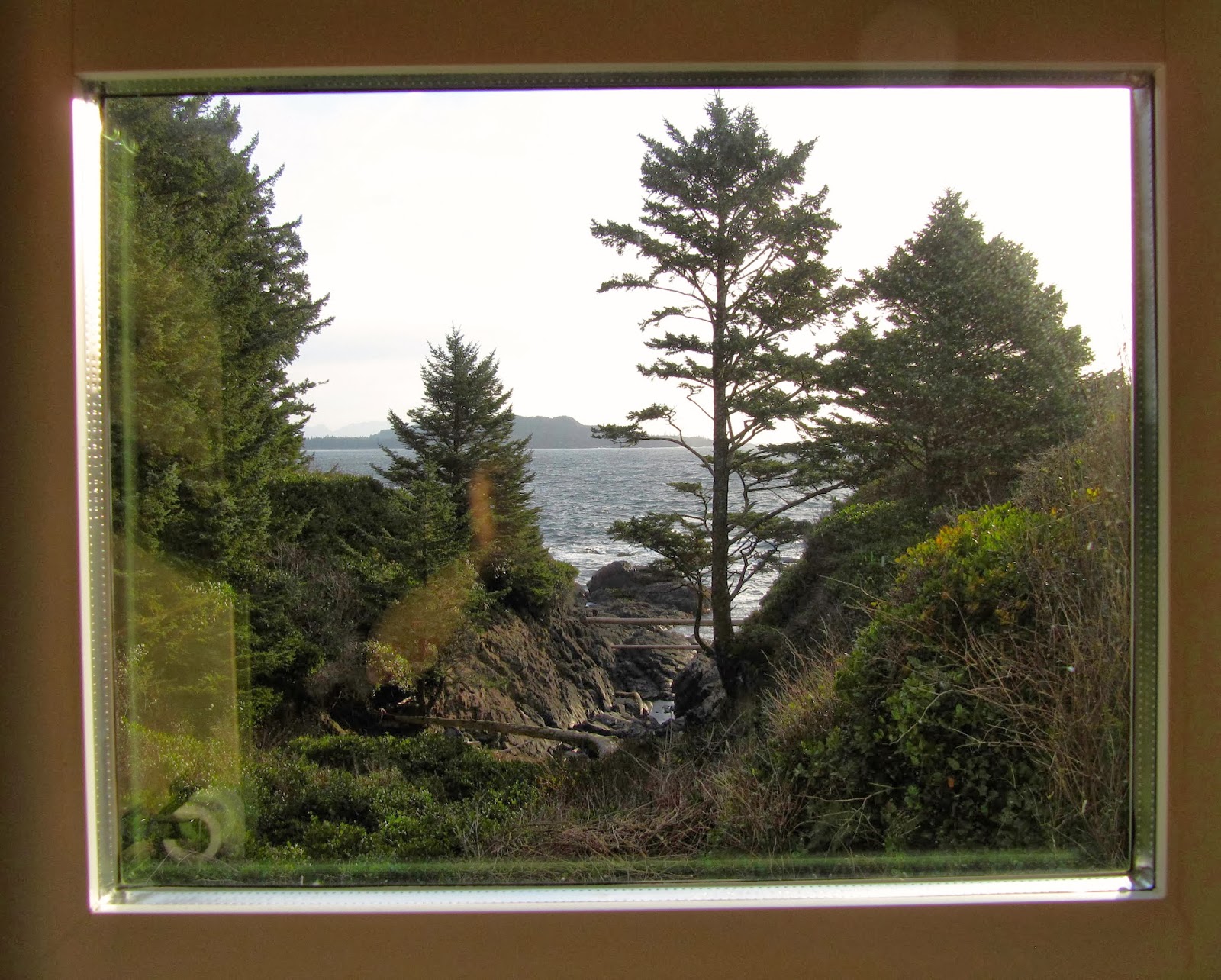
Oh yes, this is the view from my bathroom window:


And when I awoke at 3am to do the first weather this morning, this space was glowing with stars and a crescent moon. Imagine.


  LINKS TO WATCH LIVE OR CATCH THE REPLY https://www.facebook.com/wlhawkin https://www.youtube.com/@wlhawkin